
Now hiring: teachers who care as much as they know.
There are things we can teach: our methods, our approach to movement-based and multi-modal instruction, how to run a small group effectively. We will train you and support you.
There are things we cannot teach: caring about kids. Noticing the student who's about to shut down before they do. Adjusting when something isn't working instead of repeating the same thing louder. High emotional intelligence is not a skill we develop in orientation. You either walk in with it or you don't.
If you walk in with it — we want to talk.
TWO PATHS. SAME STARTING POINT.
Extra income on your schedule
Two to four hours a week, after school, Monday through Thursday — or Sundays. You set your availability. You keep your classroom job. You earn more doing what you already love, in a place that lets you actually do it.
Growth track
For teachers who are thinking beyond the classroom. Small Town Scholars is building toward a franchise model. The teachers who join early, grow with us, and lead well will have opportunities to step into leadership roles as we expand. If you want something bigger than a classroom and you're willing to build toward it — this path is for you.
Not sure which one fits? Tell us that. We'll figure it out together.
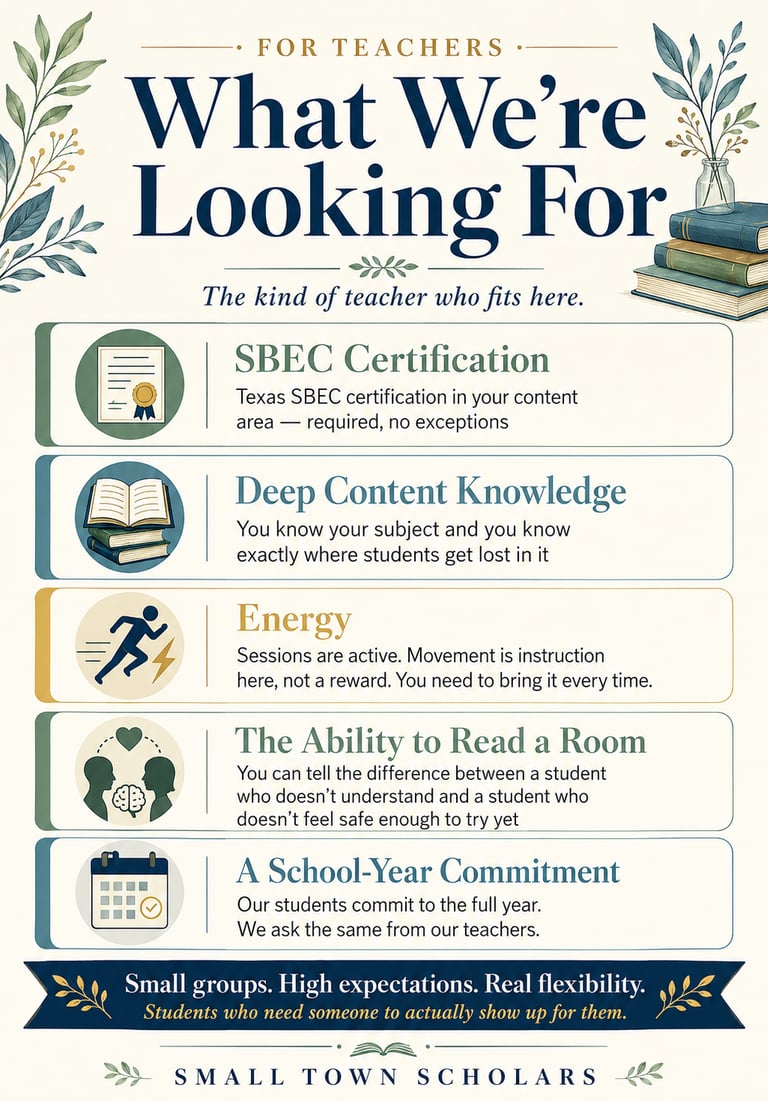
If you are interested in Joining Small Town Scholars as a TEACHER-TUTOR,
please email info@SmallTownScholars.com with the following information:
What we offer
$50/session starting with opportunities to make up to $100/session
Ongoing training in movement and multi-modal instruction
Semester and year-end bonuses
Growth opportunities
Your Name and Contact information+ certification
Content expertise and grade levels
Availability (hours/week, days, school-year commitment)
Which path interests you
Three short questions — the ones that actually tell me who you are
What do you do when you've explained something three different ways and a student still doesn't get it?
Tell me about a student you reached that others had written off.
What's the hardest part of working with a struggling student — and what do you do with that?
